
Basal and cortical implants are advanced dental implant solutions designed for patients with severe jawbone loss who are not suitable for traditional implants. These implants engage the strong cortical bone, also called basal bone, allowing patients to receive fixed teeth quickly and safely. Moreover, the bone turnover is negligible in cortical bone compared to cancellous bone. In cancellous bone, bone turnover is around 20 percent per year, whereas it is less than 2 percent in cortical bone; thus, bi-cortical engagement is a rule, not an option, in basal implantology.
the implants used in basal implantology are also made of titanium but are highly polished and hence there is zero chance for secondary infection because the implant surface itself will never attract microbes, unlike conventional implants which are rough surfaced and are highly suseptable to bacterial infections and especially in the mouth where we alwasys chew sticky food these rough surface implants always have a risk of peri implantitis (like periodontitis around implants).
The smooth surface of the basal implants prevents peri-implantitis, making them an ideal option for people with diabetes and gum disease. People with gum disease are generally at risk of peri-implantitis when rough-surface implants are placed (conventional implants are also called rough-surface implants, and basal implants are also called smooth-surface implants).
At YOUR DENTIST Advanced Dental & Maxillo-Facial Centre, Vijayawada, advanced implant procedures are performed by experienced implant surgeon Dr. E. Surendranath, with clinical support from Dr. E. Bhavya & their team ,providing reliable solutions for complex dental cases.
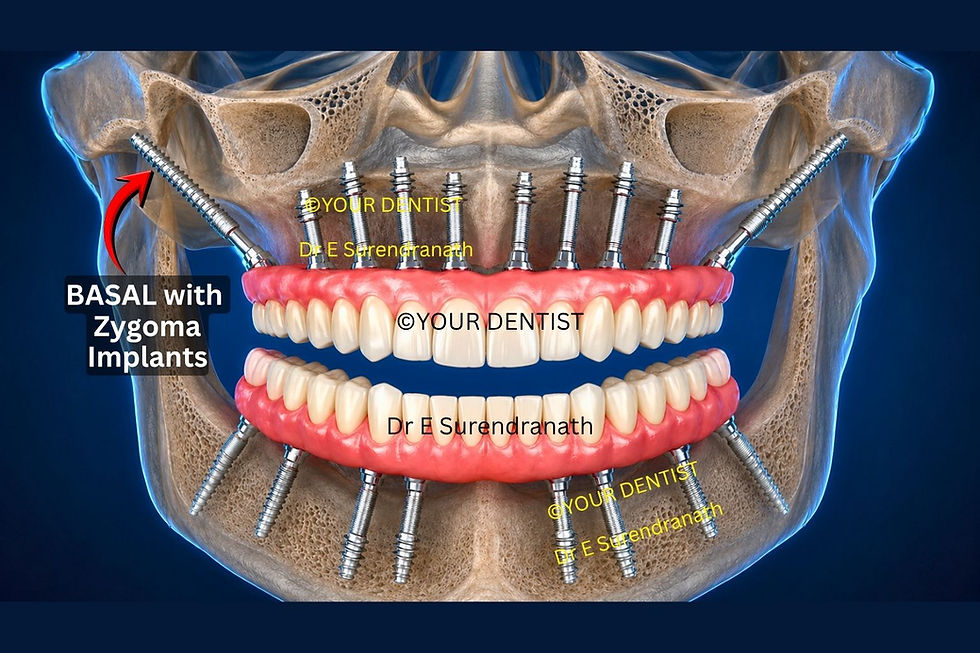
Basal & Cortical Implants in Vijayawada – Fixed Teeth Without Bone Grafting
Basal and cortical implants are specialized dental implants that are anchored in the dense cortical bone of the jaw, rather than the softer bone used in traditional implants. The softer bone, also called spongy bone, is the area where conventional implants typically engage. it is spongy in nature because it has bone marrow and haversian systems going through these spongy structure and so only the corticals of the bone are heavily dense and the rest are very much without calcification and so many conventional implantologiosts prefers loading the implants after 4 montbhs while the implant in the spongy bone gets fused with the bone within the next 3 to 4 months, but the basal implants are anchored in the second or some times 3rd cortical bone and so because of this bicortical engagement the se implants acan be loaded immediately eithin 3 to 5 days. That's why conventional implants are called delayed-loading implants, and basal implants are called immediate-loading implants.
These implants are particularly useful in cases where there is insufficient bone volume, as they rely on the strong outer bone layer for stability, and in cases where the patient expects immediate loading.
But nowadays even conventional (rough-surface implants) are available in longer sizes (once their sizes never crossed 13 mm, but now even 30 mm implants are available) just to engage the second cortical and load immediately, as only long implants, conventional or basal, will engage the second cortex.
The most important aspect of a basal implant again is the flapless placement, which means less trauma to soft and hard tissues; thus, it's called keyhole implant surgery. This type of surgery will also enable immediate loading. These days, the basal implants can be loaded with fixed teeth in just 48 hours.
Basal implants, also called single-piece implants, have the abutment fixed to the implant. In conventional implants, the abutments are available separately and need to be joined manually; these are thus called 2-piece implants.
At YOUR DENTIST Vijayawada, basal implant techniques are commonly used for full-mouth rehabilitation and complex implant cases, enabling patients to receive fixed teeth without bone grafting.
What Are Basal & Cortical Implants?
Basal & cortical implants may be recommended for patients who:
✔ Have severe jawbone loss
✔ Have been told they are not eligible for traditional implants
✔ Have failed previous dental implants
✔ Struggle with loose dentures
patients with uncontrolled diabetes
patients with severe gum disease.
patients with psychiatric problems, as they can't clean their mouths properly,
patients with aggressive periodontitis, and they lose their teeth to this disease by 30 years of age.
✔ Have long-term tooth loss leading to bone resorption
Patients who were previously denied implant treatment can often regain fixed teeth with basal implant solutions.
Who Needs BASAL & Cortical Implant Treatment?


Key Benefits
✔ No bone grafting required
✔ Strong anchorage in cortical bone, often called bicortical fixation
✔ Suitable for severe bone loss patients
✔ Immediate or early loading possible
✔ Faster treatment compared to conventional implants
✔ Long-term stability for full-mouth restoration because they have a smooth surface, and thus the chance of infection is close to zero.
These implants provide a reliable solution for patients seeking permanent fixed teeth.
Benefits of Basal & Cortical Implants
At YOUR DENTIST Advanced Dental & Maxillo-Facial Centre, Vijayawada, the treatment process includes:
1️⃣ Clinical Examination
Detailed assessment by Dr. E. Surendranath and the implant team.
2️⃣ CBCT 3D Imaging
Evaluation of bone density , structure, and the distance for second cortical engagement, which is very much essential for bi-cortical engagement.
3️⃣ Digital Implant Planning
Accurate implant positioning using software. We at your dentist's office use advanced blender software to make stackable guides and also Blue Sky Bio software for preliminary planning.
4️⃣ Implant Placement Surgery
Basal implants are anchored into cortical bone for strong stability. Unlike conventional implants, basal implants are placed in larger numbers to facilitate immediate loading. Typically, with conventional implants, 6 implants are placed in each jaw, but with basal implants, at least 10 are placed in each jawbone, all engaged bi-cortically. This engages all available bone and both cortices, increasing primary stability for immediate loading.
5️⃣ Temporary Teeth Placement
In many cases, fixed permanent teeth are provided quickly, and temporary teeth are rarely used in basal implantology.
6️⃣ Final Prosthetic Restoration
Due to the keyhole surgery for implant placements, the necessity for temporary crowns is often eliminated, and the permanent crowns can be given directly.
Treatment Procedure of Basal & Cortical Implants
At YOUR DENTIST Advanced Dental & Maxillo-Facial Centre in Vijayawada, advanced digital dentistry ensures accurate and safe implant procedures.
-
CBCT 3D imaging and also dual CBCT protocols for patients opting for guided implants
-
Guided implant surgery with in-house guide manufacturing using advanced 3d printers and Blender licensed software
-
Digital implant planning software with Bluesky Bio
-
Medit intraoral scanner, and also a laboratory scanner in case normal impressions were opted for due to bleeding in immediate loading cases
-
CAD/CAM prosthetic design with licensed Exocad software, and we have a full-time CAD/CAM technician, and in-house doctors are trained in CAD/CAM, and Dr. Surendranath himself can operate CAD/CAM, and that's a big advantage for our patients, as they can get what they are actually expecting.
-
In-house zirconia milling lab with advanced mill box software, a four-axis Roland milling machine imported from Germany, and a 5-axis Roland DWX 52di machine, also imported from Germany. And it's a record for an in-house laboratory to have 2 milling machines. In all of South India, we are the only clinic to have 2 in-house CNC milling machines for milling PMMA, zirconium, graphene, hipc, wax, trinia, lithium disylicate, etc.
These technologies ensure precision, safety, and predictable outcomes.
Advanced Implant Technology Used at OUR Clinic
Basal implant techniques may include:
-
Single basal implants are often bound to fail, so only full-mouth cases are preferred with basal implants due to cross-arch stabilization. For single teeth or sectional tooth loss, we still prefer conventional implants on any given day.
-
full mouth multi-unit basal implants with screw-retained tooth sets
-
Immediate loading basal implants with cement-retained tooth sets (most commonly used)
These solutions are ideal for complex cases of bone loss.
Types of Advanced Basal & Cortical Implant Solutions
Recovery after basal implant surgery is usually smooth with minimal discomfort.
-
Mild swelling for 2–3 days, some bleeding from the nose, and some paraesthesia are common, and these symptoms settle in a week.
-
Improvement within one week. Quick return to daily routine,most people return to normalcy within a week, and in zygomatic implant surgery, it might take a week more. As even in basal implantology, the zygomatic implants, often called the basal zygomas, need full flap reflection for proper placement, and keyhole surgery can't be performed.
-
Soft diet during initial healing, and it's the most important factor for the 1st 3 months; until then, the implants would completely osseointegrate.
-
Regular follow-up visits are required.
Most patients can resume daily activities quickly after treatment.
Recovery After Basal & Cortical Implant Surgery
Proper aftercare is essential for long-term success.
-
Maintain oral hygiene, which is a must, and it's often beneficial to add a regular mouthwash to your brushing routine.
-
Avoid hard foods initially for at least 3 months; foods like rice, idlis, dosa, and soft rotis are considered soft foods and are completely safe even in the 1st 3 months. All curries can be considered soft foods and are completely safe even in the 1st 3 months.
-
Follow the doctor's instructions for any specific care.
-
Attend regular follow-ups, which are a must and can help with occlusal adjustments, which are very much needed in the 1st year until your bite adjusts.
-
Professional implant cleaning is mandatory every 6 months.
Regular monitoring at YOUR DENTIST Vijayawada ensures optimal results.
Aftercare for Basal & Cortical Implants
Basal implants are safe when performed by experienced surgeons, but possible risks include:
-
Swelling or minor discomfort in the 1st week of surgery
-
mild bleeding from the nose
-
Severe itching caused by the antibiotic tablets; you can report this so our team of dentists can change the tablets.
-
Infection (rare with proper care) can be managed with the antibiotic options available today.
-
Implant failure (very rare), with a probability of 1 in 1 lakh.
-
Prosthetic adjustments, if required, are to be done a few times in the very 1st year; after that, we need not bother with them, as you will have fully adjusted to the dentures.
At YOUR DENTIST, advanced planning minimizes these risks.
Expected Complications of Basal & Cortical Implant Surgery
Patients choose YOUR DENTIST Advanced Dental & Maxillo-Facial Centre because of:
✔ Expertise in complex implant procedures
✔ Advanced digital planning technology
✔ In-house dental lab
✔ Modern surgical infrastructure
✔ Personalized treatment approach
Led by Dr. E. Surendranath with support from Dr. E. Bhavya, the clinic focuses on long-term implant success.
Why Choose YOUR DENTIST for Basal & Cortical Implants in Vijayawada
Basal implants help patients achieve:
✔ Fixed teeth instead of removable dentures
✔ Improved chewing ability
✔ Better speech and comfort
✔ Enhanced smile confidence
Patients with severe bone loss can regain normal oral function and quality of life.
Smile Restoration with Basal & Cortical Implants


Patients from Vijayawada and nearby Cities and neighboring states such as Telangana, Tamil Nadu, Karnataka, Hyderabad, Bengaluru, Coimbatore, and within Andhra Pradesh, such as Vishakapatnam, Nellore, Tirupati, Guntur, Tenali, Eluru, Machilipatnam, Amaravati, and Nuzvid, visit the clinic for advanced implant treatments, including:
-
Basal implants
This makes the clinic a trusted destination for advanced dental implant treatment in Vijayawada.
Basal & Cortical Implant Treatment in Vijayawada
Are basal implants better than traditional implants?
In cases of severe bone loss, basal implants can be a better option, as they avoid the need for bone grafting. Not only does it avoid grafting, but it also engages thick second corticals of the jawbone, and hence, this bicortical engagement gives it more chances to survive immediate loading.
How long do basal implants last?
With proper care, they can last many years, decades, in fact, as these are highly polished implants. So the polished titanium surface will prevent secondary infection, and peri-implantitis is the leading cause of implant failure. It is common with conventional implants, but in basal implants, the risk of peri-implantitis is negligible. Hence, long life is expected even in patients with diabetes.
Is basal implant surgery painful?
The procedure is done under anesthesia, and discomfort is minimal. Moreover, basal implantology advocates against raising the full mucoperiosteal flap, which means it is essentially a flapless surgery; thus, minimal discomfort is experienced, as surgical trauma is reduced by about 96 percent, and there will be no suturing as well.... It's often called bloodless, stitchless, painless implantology.
What is the cost of basal implants in Vijayawada?
The cost is generally around 1.5 lakh rupees per jaw. This price is very low compared to our quality, as we, your dentist, use only Swiss-imported implants, not local brands. Hence, this price is considered the lowest in the market for Swiss root b implants and DMLS framework ceramic teeth. And for a full mouth (i.e., both the upper and lower jaws), it's 3 lakhs.
Frequently Asked Questions
Patients visiting YOUR DENTIST Advanced Dental & Maxillo-Facial Centre in Vijayawada for basal implants often present with severe jaw bone loss, long-term missing teeth, or have been previously advised against conventional implant treatments.
Real case examples may include:
-
Severe Bone Loss Treated with Basal Implant Full Mouth Rehabilitation
-
Immediate Loading Fixed Teeth Using Cortical Implant Support
-
Failed Conventional Implant Cases Re-treated with Basal Implants
-
Long-Term Denture Users Converted to Fixed Implant Teeth
-
Complex Cases Managed Without Bone Grafting Using Basal Techniques
These real patient cases demonstrate how basal implant techniques utilize strong cortical bone to provide stable, fixed teeth solutions even in challenging conditions, under the expertise of Dr. E. Surendranath and the implant team.
Real Patient Case Studies
Patients considering basal implants often have severe bone loss, long-term missing teeth, or have been advised against conventional implants due to insufficient bone support. Understanding this advanced technique helps patients make informed treatment decisions.
At YOUR DENTIST Advanced Dental & Maxillo-Facial Center, Vijayawada, we provide detailed educational blogs that explain how basal and cortical implants work and when they are recommended.
You can explore:
-
Basal Implants vs Conventional Implants: How Immediate Fixed Teeth Work
-
Immediate Fixed Teeth in Vijayawada with Basal Implants | Real Results
These blogs help patients understand how basal implants differ from conventional implants and why they are often recommended for complex cases of bone loss.
Learn More About Basal Implants & Advanced Solutions
Patients exploring Basal & Cortical implants may also be interested in other advanced implant treatments available at YOUR DENTIST Vijayawada, including:
Related Implant Services
Resident Dental Surgeon supporting implant procedures and patient care.
Together, they with their team of doctors provide comprehensive implant solutions at YOUR DENTIST Vijayawada.
8+ years experience, 6000+ implant surgeries
Resident Dental Surgeon
Dr. E. Bhavya

Dr. Surendranath is a Maxillofacial Surgeon and Implantologist with over 15 years of expertise. He specializes in advanced dental implantology, including BASAL & Cortical Implants, Zygoma implants, Quad Zygoma Implants, PAZTI Implant Protocol, and All-on-4/6 with Zygomatic implants, and has successfully completed more than 30,000+ implant surgeries. Known for his precision and patient-focused care, he leads YOUR DENTIST in providing world-class dental solutions.
15+ years experience, 30,000+ implant surgeries
M.D.S(OMFS), Implantologist
Dr. E. Surendranath


If you have been told that you do not have enough bone for dental implants, basal & cortical implants can help you regain fixed teeth without bone grafting.
Consult Dr. E. Surendranath and Dr. E. Bhavya at:
YOUR DENTIST Advanced Dental & Maxillo-Facial Center
Vijayawada, Andhra Pradesh
🌐 www.yourdentists.in
📞 Call Us: 92933 98888 | 96948 29999
📧 Email: info@yourdentists.in
📌 Location: https://g.page/mee-dentist
Book your consultation today.