top of page

Dental implants are not just about placing a screw in the jaw.Their long-term success depends heavily on where, how, and at what angle the implant is placed.
3D CBCT-based implant planning is a modern digital approach that allows dentists and surgeons to plan implant placement before surgery, using a three-dimensional scan of the jaws, bone, nerves, and sinuses.
This technology has transformed implant dentistry from estimation-based to precision-based treatment.
What Is a CBCT Scan in Dentistry?
CBCT stands for Cone Beam Computed Tomography.
A CBCT scan:
Captures a 3D image of your jaws
Shows bone height, width, and density
Clearly maps nerves, sinuses, and vital structures
Provides far more information than a regular X-ray
💡 In simple terms: CBCT lets the dentist see inside the jaw in three dimensions.
Why Regular X-Rays Are Not Enough for Implant Planning?
Traditional 2D X-rays:
Show only height, not width of bone
Overlap structures
Cannot accurately show nerve position
Can hide sinus anatomy
For complex implant cases, relying only on 2D X-rays increases the risk of:
❌ Nerve injury
❌ Sinus perforation
❌ Poor implant angulation
❌ Implant failure
This is why CBCT is now considered the gold standard for implant planning.
What Is 3D CBCT-Based Implant Planning?
3D CBCT-based implant planning means:
Taking a CBCT scan
Digitally analyzing bone, nerves, and sinuses
Virtually placing implants on a computer before surgery
Selecting ideal implant size, position, and angle
The actual surgery then follows this pre-planned digital roadmap.
How 3D Planning Improves Implant Safety?
CBCT-based planning allows surgeons to:
✔ Avoid nerves in the lower jaw
✔ Avoid sinuses in the upper jaw
✔ Choose the strongest available bone
✔ Control implant depth and angulation
✔ Reduce surgical surprises
This significantly lowers the risk of complications during and after surgery.
Accuracy & Precision in Implant Placement
With 3D planning:
Implants are placed in prosthetically ideal positions
Bite forces are better distributed
Final teeth fit more accurately
Long-term stability improves
This is especially important for:
All-on-4 / All-on-6
Zygoma & Pterygoid implants
Basal & Cortical implants
Full-mouth rehabilitation
Guided implant surgery
Role of CBCT Planning in Complex Implant Cases
CBCT planning is critical in cases involving:
Severe bone loss
Failed implants
Sinus-related problems
Nerve-proximate implant sites
Full-arch implant treatments
Without CBCT, these cases carry higher risk.
CBCT Planning + Digital Dentistry = Better Outcomes
When CBCT planning is combined with:
Digital implant software
Guided surgical techniques
In-house prosthetic planning
The result is:
✔ Better accuracy
✔ Less invasive surgery
✔ Faster recovery
✔ Predictable outcomes
This integration is the future of implant dentistry.
Does CBCT Reduce Pain and Recovery Time?
Indirectly, yes.
Because surgery is:
Better planned
More precise
Less traumatic
Patients often experience:
Less surgical trauma
Reduced swelling
Faster healing
Fewer complications
Is CBCT Safe?
Yes.
Dental CBCT scans:
Use low radiation doses
Are targeted only to the jaw area
Are considered safe when clinically justified
The diagnostic benefits far outweigh the minimal exposure.
Who Needs 3D CBCT-Based Implant Planning?
CBCT planning is recommended for:
✔ All implant patients
✔ Full-mouth implant cases
✔ Complex bone conditions
✔ Immediate implant planning
✔ Guided implant surgery
In modern practice, CBCT is no longer optional — it is essential.
Why Implant Planning Matters More Than Implant Brand?
Even the best implant system can fail if:
It is placed in poor bone
Angulation is incorrect
Nerves or sinuses are compromised
Proper planning determines success more than the implant brand itself.
6 Jan 2026
3D CBCT-based implant planning uses advanced digital scans to place dental implants safely and accurately. Learn how it reduces risks, improves precision, and increases long-term implant success.
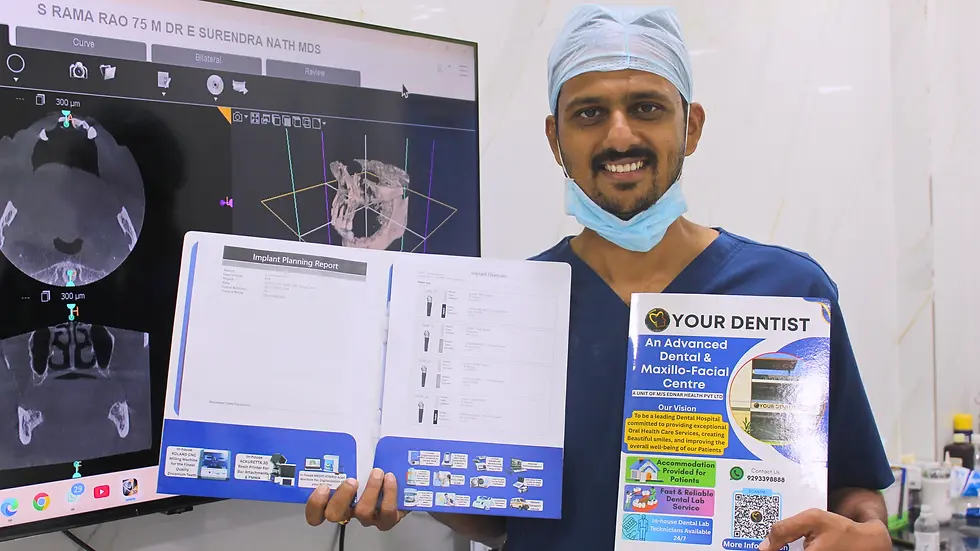
3D CBCT-Based Implant Planning: How Digital Technology Makes Dental Implants Safer
Yes, it uses low radiation and is widely accepted.
Is CBCT safe?
No, it is a quick, non-invasive scan.
Is CBCT painful?
Yes, it significantly improves safety and precision.
Does CBCT reduce implant failure risk?
For safe and accurate implant placement, yes.
Is CBCT required for dental implants?
It is digital planning of implant placement using a 3D CBCT scan.
What is CBCT-based implant planning?
Frequently Asked Questions
Dr. Surendranath is a Maxillofacial Surgeon and Implantologist with over 15 years of expertise. He specializes in advanced dental implantology, including All-on-4, All-on-6, and Zygomatic implants, and has successfully completed more than 25,000 implant surgeries. Known for his precision and patient-focused care, he leads YOUR DENTIST in providing world-class dental solutions.
15+ years experience, 25,000+ implant surgeries
MDS, OMFS, Implantologist
Dr. E. Surendranath

bottom of page