top of page

Hearing that your root canal has failed can be disappointing and confusing. The next question most patients ask is:
“Should I save the tooth, or should I remove it?”
Dentists usually present two options:
Apicoectomy (root-end surgery)
Tooth extraction
Both are valid treatments — but they serve very different purposes. Understanding the difference helps you make the right decision for your long-term oral health.
Why Do Root Canals Sometimes Fail?
A root canal may fail due to:
Complex or hidden canals
Persistent infection at the root tip
Missed canals
Root fractures
Delayed or leaking crown
Resistant bacteria
When infection remains at the root tip despite treatment, further intervention is needed.
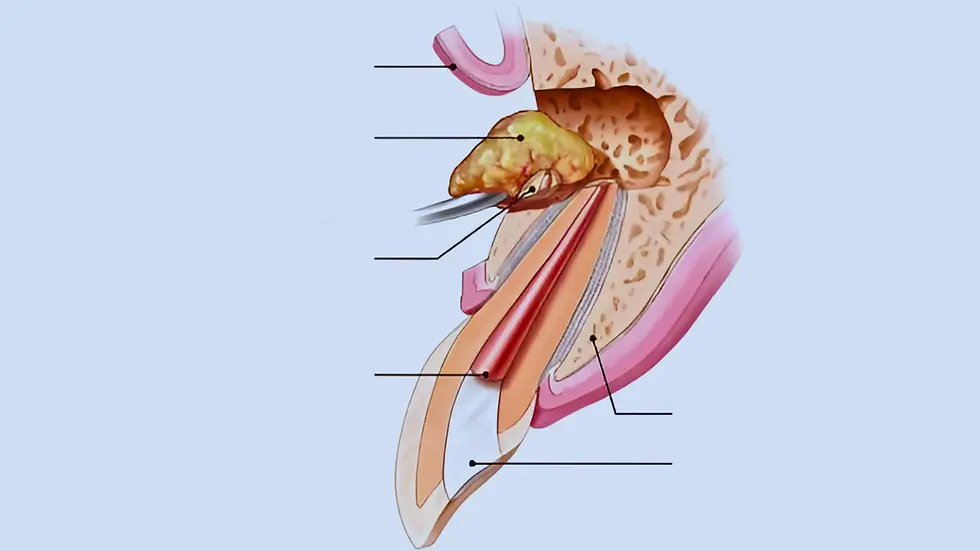
What Is Apicoectomy?
Apicoectomy is a tooth-saving surgical procedure where:
The infected tip of the root is removed
Surrounding infected tissue is cleaned
The root end is sealed to prevent reinfection
Instead of approaching from the crown, apicoectomy treats infection from the root end through the gum and bone.
Goal:
✔ Preserve the natural tooth
✔ Eliminate infection
✔ Avoid extraction
What Is Tooth Extraction?
Tooth extraction involves removing the tooth completely from the jaw.
Extraction may be recommended when:
The tooth is severely fractured
The remaining tooth structure is weak
Infection cannot be controlled
Apicoectomy is not feasible
Long-term prognosis is poor
After extraction, replacement options may include implants, bridges, or dentures.
Apicoectomy — Pros & Cons
Advantages
Saves the natural tooth
Maintains chewing efficiency
Preserves jawbone
No need for artificial replacement
High success rate (85–95%)
Limitations
Minor surgical procedure
Not suitable for all teeth
Requires good bone and tooth support
Apicoectomy is usually preferred when the tooth structure is strong and infection is localized.
Tooth Extraction — Pros & Cons
Advantages
Completely removes infection
One-time solution
Suitable for badly damaged teeth
Limitations
Permanent loss of natural tooth
May require implant or bridge
Higher long-term cost
Bone loss at extraction site
Longer overall treatment time
Extraction solves the infection but creates a new problem — missing tooth replacement.
Which Option Is Better? It Depends on the Tooth
There is no one-size-fits-all answer.
Apicoectomy is preferred when:
Tooth structure is healthy
Crown and roots are stable
Infection is localized at root tip
Retreatment is not possible
Patient wants to preserve natural tooth
Extraction is preferred when:
Tooth is cracked beyond repair
Severe bone loss is present
Infection is widespread
Long-term success is unlikely
Expert evaluation is essential.
How Specialists Decide the Best Option?
At YOUR DENTIST, decision-making includes:
Clinical examination
Digital X-rays
3D CBCT scan to assess:
Root anatomy
Bone condition
Extent of infection
Proximity to nerves or sinuses
The goal is always maximum safety with best long-term outcome.
Is Saving the Tooth Always Better?
In most cases, yes.
Natural teeth:
Feel better
Function better
Preserve bone naturally
Require less maintenance than replacements
However, saving a tooth that has a poor prognosis can lead to repeated problems.That’s why honest evaluation matters more than “saving at all costs.”
What Happens If You Delay the Decision?
Delaying treatment can cause:
Spread of infection
Bone loss
Increased pain
Reduced chance of saving the tooth
Early intervention gives you more treatment options.
Why Expert OMFS Care Matters?
Root-end surgery and extraction both involve:
Bone
Infection control
Precision near vital structures
An Oral & Maxillofacial Surgeon is trained to evaluate both options objectively and perform the chosen treatment safely.
27 Jan 2026
When a root canal fails, should the tooth be saved with apicoectomy or removed? Learn the pros, cons, and how specialists decide the best option.
%203.webp)
Apicoectomy vs Tooth Extraction: Which Is Better for a Failed Root Canal?
When successful, it can save the tooth for many years.
Is apicoectomy a permanent solution?
In most cases, yes — to prevent bone loss and bite problems.
Does extraction always need replacement?
Yes, when the tooth can be saved safely, apicoectomy is preferred.
Is apicoectomy better than extraction?
Frequently Asked Questions
Dr. Surendranath is a Maxillofacial Surgeon and Implantologist with over 15 years of expertise. He specializes in advanced dental implantology, including All-on-4, All-on-6, and Zygomatic implants, and has successfully completed more than 25,000 implant surgeries. Known for his precision and patient-focused care, he leads YOUR DENTIST in providing world-class dental solutions.
15+ years experience, 25,000+ implant surgeries
MDS, OMFS, Implantologist
Dr. E. Surendranath

bottom of page